Tuesday, 23 October 2012

Bath Foodcycle Presents: Soulfood - Review

https://fbcdn-sphotos-e-a.akamaihd.net/hphotos-ak-snc6/189034_353217684770856_2123169198_n.jpg
Last Friday (20 October), Bath Foodcycle put on a fundraising night consisting of a three-course meal for 34 people and a night of bluegrass music attending by around 100 people, raising £918 for the cause. Bath Foodcycle is part of a volunteer-run national movement that takes surplus and waste food from supermarkets and other food retailers than would otherwise be destined for landfill, and uses it to cook food for people who do not have access to healthy foods.

All food was vegetarian with vegan options. The starter was a delicious red lentil and red pepper dip with potato wedges. The main course was 'soul stew' with pumpkin and kidney beans and a spiced rice, with enough for a much-welcomed second helping. Dessert was a yoghurt bread pudding (vegetarian) or fruit crumble (vegan).All who sat on my table enjoyed their meal immensely, and were pleasantly surprised at how good a meal made from waste food could be. Gin with iced tea complemented the meal perfectly, and some went back for a few more of these.

The music was provided by the Gollywhoppers, Big Green Uncle, Slapface and the Hoagies, Bryan Chalker & Out of the Brew and Swamp Donkey. All provided excellent entertainment, however regrettably I was only able to review Big Green Uncle from the night.

Big Green Uncle

Adam Timmins, Steve Hatch and Matthew J Young from Big Green Uncle really look the part. You can imagine these guys hanging out on the edge of a ranch in the mid-west, railroad running past, empty whiskey bottle on the floor, areefer being passed round and animals running around at their feet while they strum. A really tight-sounding band who evidently love their bluegrass. Although their set consisted of covers, they played them vibrantly and with soul, with song topics ranging from trains, chickens and getting drunk and stoned, the latter involving the audience shouting "to get high!" during the chorus. And high they were, in the audience appreciation stakes. A fun band with who despite their apparent love and dedication to the genre, don't take themselves too seriously and a real pleasure to watch, and the performance never once stumbled or got boring. The most surprising thing about Big Green Uncle is that this was their very first gig and that  formed specifically for the Soulfood event. Since this gig they have decided to continue as a band and already have more gigs organised. For something a little different, fun and enjoyable, catch these guys next time they play!

Facebook: https://www.facebook.com/BigGreenUncle

Phoebe Kitcher, one of the Foodcycle staff, said "The event was a huge success, and we're very grateful to all involved. Can't wait for the next one!" Bath Foodcycle is going to be cooking for three weeks in St Mary's Church on Julian Road, Bath in November (dates to be confirmed) and will be providing cheap meals. Following this, they will be putting on the Bath Bake-Off in December. Keep up to date with Bath Foodcycle on the links below, and if you want to sign up or find out more about becoming a volunteer, visit the national website http://foodcycle.org.uk/.

Bath Foodcycle Facebook: https://www.facebook.com/bathfoodcycle
Bath Foodcycle Website: http://bathfoodcycle.wordpress.com/


Monday, 15 October 2012

Pussy Riot Benefit Gig, Green Park Tavern, Bath 12th October 2012 - Review

It's only when we're serious and start to make fuss,
That the smug politicians show their real face.
- Crass "You're Already Dead", 1984 

They're one of the most talked about bands at the moment, their story has been printed in pretty much every daily newspaper on the planet and they're on the news every other night - yet you won't find their music in your local record store. They are punk to the core - intelligent, rebellious, shocking and politically-charged. Pussy Riot are more than just a band. Like Anonymous and some Occupy protesters, they cover their faces while in public. Pussy Riot could be anyone. They are an anonymous political force, standing up for women and against the corrupt leader of their country.

Rock music has a long and colourful history of bands and artists standing up to authority and highlighting issues - from popular fund-raisers such as Live Aid to the Sex Pistols boat trip on the Queen's Silver Jubilee, John Lennon and Yoko Ono lying in bed to Rage Against the Machine in Guantanamo Bay-style boiler suits, Julian Cope's display of support for the Newbury Bypass protests on the ground and on Top of the Pops, to the Rock Against Bush movement founded by NOFX bass player and vocalist Fat Mike, the Rock Against Racism movement and Brian May's recent opposition to the badger cull - all big news and arguably heroic acts. But few have caught the attention of the world's media in quite the same way as Pussy Riot.

Going back a few months, three members were arrested for singing a "punk prayer" against President Vladimir Putin in the Cathedral of Christ the Saviour in Moscow. One member has been released, while the remaining two face several years of imprisonment - for standing up for themselves and others, and causing no harm to anyone, except Putin's credibility on the world stage.

Amnesty International have launched a campaign to free the imprisoned girls, and tonight is a both a fundraiser for the campaign and a celebration of awesome local female-fronted rock and roll. 

Jemima Surrender


Jemima Surrender
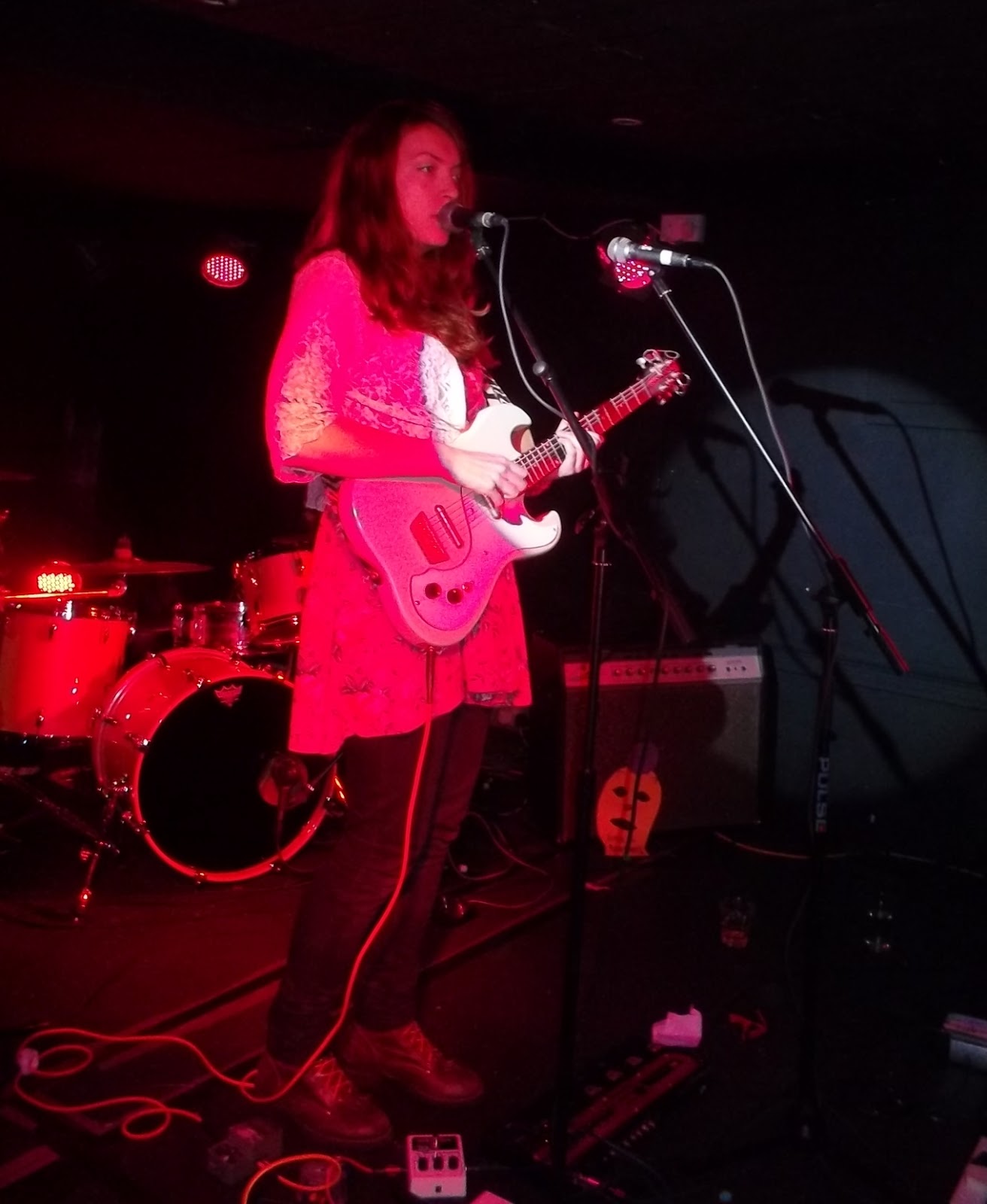
First on stage is a one-woman set that can rock harder than most hard rock bands and just moments later slip into sweet, seductive melodies. Jemima's vocal style falls somewhere between a less-gravelly Kim Gordon, with the manicness of Kristen Hersch, and makes clever usages of vocal sampling to add depth to her songs. Named after a song by The Band and inspired as much by 1960s French pop music, such as Jacques Dutronc, as by the Riot Grrrl movement, and using unusual timings, Jemima delivers a strong performance and pushes the boundaries of a solo performance to the limits. A unique talent and a great choice by the organisers to kick off tonight's event.


Website: http://jemimasurrender.wordpress.com/
Facebook: https://www.facebook.com/JemimaSurrender?sk=wall&filter=3


Annette Berlin

Annette Berlin
Next up on the bill is Annette Berlin, featuring Annete on guitar and microphone and Keith on drums, and providing the first full-on rock-out of the evening. Featuring crunchy, grungey riffs, descending chord progressions, some nice bouncy rhythms, a strong vocal delivery that demands attention and unashamed basking in the glory of the quiet-loud-quiet-loud song structure, Annette Berlin had heads banging from the first note. Reminding me of early Love is All but without the image (a good thing in my book) and Rid of Me-era PJ Harvey, with grinding guitar riffage reminscent of Alice in Chains' Dirt album, from the front to the back of the crowd this set managed to get just about everyone moving approvingly. More from them in the future - please!

Website: http://annetteberlin.bandcamp.com/
Facebook: https://www.facebook.com/pages/Annette-Berlin/42788206965

The Hysterical Injury

The Hysterical Injury
A second two-piece, and possibly the best band to have ever graced the stage of the Green Park Tavern, this band had me running to the back, finding friends, shouting "this is brilliant!" and dragging them down to the front. Let me explain. This is surely the coming of the bass guitar as a lead instrument used to its fullest extent. There's no 6-string mcguffery going on in this drum/bass and voice act, and I swear I'll never look at a sub-standard bass-player in the same way again. Poppy, yet etheral vocals entrance, at the same time exuding the very essence of punk rock, and the beats force even the most reluctant body to rock out. Annie sings and looks like a woman enraptured and possessed by some awesomely freaky and powerful feminine force of nature, and I'm going to quit writing and start head-banging. They had better not play round these parts too often or this blog will turn into an unofficial fan page, and that's a promise. See this band!

Website: http://hystericalinjury.bandcamp.com/
Facebook: https://www.facebook.com/thehystericalinjury

Thought Forms

Thought Forms
The most important task of the organisers of an event like this is to ensure that the final act does not disappoint - and they knew what they were doing when they booked the excellent Thought Forms. Ambient stoner-rock incorporating Earth-esque trip outs and indie guitar freak-outs with sparse primitive and tender male and beautiful female vocals buried amonst the sonic soundscapes with few, if any, audible lyrics had all the members of the previous bands down the front rocking out to this three-piece - the perfect ending to a fantastic night in support of an inspiring punk band.

Website: http://www.thought-forms.co.uk/
Facebook: https://www.facebook.com/pages/Thought-Forms/6171829460


A great night out, and one of the most exciting musical events in Bath for some time. Pussy Riot would surely have been dancing down the front, balaclavad and rocking out with the rest of us. In fact...
Pussy Riot, Bath

Sunday, 14 October 2012

Badger Cull - Protest Against Tesco in Bristol

Yesterday (13th October), around 25 anti- badger cull activists held a demonstration outside the Tesco Metro store in Broadmead, Bristol, and with many wearing black "Fuck the Cull" t-shirts or badger masks, we looked like we meant business. Tesco sell milk from the cull areas and the demonstration was intended to highlight this issue and ask people to buy their milk from stores that do not buy their milk from these areas, such as the Co-op, Waitrose and Marks and Spencer.

Badger cull demonstration outside Tesco, Broadmead, Bristol 13/10/12

Several hundred leaflets were handed out to shoppers, many of whom stopped to chat about the cull and find out more, or ask what they could to help. Few were undecided - many people expressed their disgust about the cull and some enquired about the scientific facts - which we had to hand and were able to answer their questions.

Signs outside Tesco
A further demo is planned for Tues 16th October at 11am outside the same Tesco (Facebook event page: https://www.facebook.com/events/365084693574574/366478960101814/), and a Bath demo is planned for Sat 27th October outside Sainsbury's Local in Kingsmead Square (Facebook event page: https://www.facebook.com/events/477853698915003/).

Saturday, 13 October 2012

Badger Cull - Walk on the Forthampton Estate, Gloucestershire


The following is re-posted from Stop the Cull...

This Sunday we call all of you who care about badgers to put on your waterproofs, grab your maps and head to the Forthampton Estate. 3,000 acres all signed up and paid for the badger cull.

3,000 acres is over 4 square miles, which is approximately 3% of the badger cull zone.

The Yorke family who own the estate run a massive shooting business, they offer the killing of pheasant, duck and partridges for entertainment to syndicates and corporations. It is also a very popular bit of land for the Ledbury hunt to go killing foxes on, so for hunt sabs it is going to be particularly important.

We already have confirmation of nearly 100 hunt sabs coming this Sunday, any shooting going on will be stopped immediately by us.

If you would like to get involved with something a little less confrontational this Sunday we ask you to walk the PUBLIC foothpaths that criss cross this estate and make a note of any pheasant pens or partridge enclosures or anything else that is suspect.

Book mark this page http://badger-killers.co.uk/forthampton-estate-sunday-141012-9am-midnight-we-will-rock-you/ and check it Saturday evening, we will put up more details as we have them. For now it is up to you to start doing what you can to make arrangements.

Consider this a pre-emptive strike.


Forthampton Shoot Website:  http://www.gunsonpegs.com/shooting/buy/shoots.php?id=2917&fb_source=message

 Map of the estate here: http://badger-killers.co.uk/map-for-forthampton/


Live Music Reviews

The Bath Chronicle is no longer reviewing theatre, music or any other performance art from any venue except for the Theatre Royal (see my previous blog post for more info), and let's face it, their reviews were always rubbish anyway. As of now, Standing Stone's Blog will be helping to fill the gap with live music reviews. As time and money is limited, not every gig can be attended, and those reviewed will largely be artists that fall within the taste of the author of this blog - however if you attended a gig in Bath that you feel deserves a review, please feel free to get in touch and contribute - guest posts on this blog are encouraged (as long as you are not the artist in question, of course)!

With no journalistic training and at the start of this project having never written a music review ever, the quality may not be great, but at least someone's doing it.

This will not affect the usual reporting on activism and opinion pieces - these will continue as usual, posted whenever anything noteworthy happens round these parts.


Monday, 8 October 2012

South West Food Not Bombs - Meeting on 26th October

Food Not Bombs - an international peace movement that collects food destined for the bin, cooks it and supplies it to those in need, protest movements, events and anyone else - is the latest addition to the growing number of charities, activist and campaign groups operating in Bath.

With an ambition to eventually set up a network throughout the south west, the group recently held a start-up meeting and has an increasing number of followers on Facebook. Now that initial hurdles are being overcome, they are in a position to start organising things and have called a meeting for Friday 26th October at St James Wine /vaults (upstairs), Bath at 7.30pm to discuss the next step and to generate ideas. With several passionate people behind it and many more expressing keen interest, the group has got off to a promising start and ideas are already being put forward for events.

More information on their website http://www.swfnb.moonfruit.com/#

The Facebook page is here:https://www.facebook.com/pages/Southwest-Food-Not-Bombs/501415996539504
Meeting event page here (check here for latest news and any alterations to venue etc.): https://www.facebook.com/events/386045128133842/?ref=ts&fref=ts


Wednesday, 3 October 2012

Bath Chronicle to Stop Printed Reviews of Live Events From Anywhere Except the Theatre Royal

The Bath Chronicle has stated that it is no longer going to print performance reviews from any venue except for the Theatre Royal, and will put a limited number of reviews from other venues on their website. They will be explaining further at a public meeting on Monday 8th October 17.30 - 19.30 at the Mission Theatre. If you plan on attending, or have a question that you would like to asked on your behalf, please respond to the Facebook event page or e-mail info(at)theatrebath.co.uk. Places are filling up, so please get in contact with them ASAP if you are intending to go.

Bath has a diverse and exciting art culture that goes way beyond the Theatre Royal. The Mission Theatre, Chapel Arts Centre, Rondo Theatre and others also put on great theatre talent. The nearby Komedia has built a reputation for putting on well-known and rising stars on the stand-up scene, and also as a music venue, playing host to a number of well-known names of the past couple of years including The Levellers, Ash, Julian Cope, Stiff Little Fingers and Half-Man, Half-Biscuit. Moles and the Porter Bar have for years championed up and coming talent, and further diversity on the Bath live music scene is brought by smaller venues such as The Bell, The Royal Oak and The Green Park Tavern - and even more venues feature occasional live music as well as DJ sets, performance poetry and stand-up comedy. Artists - in particular up and coming artists - often struggle to get themselves promoted. Having performed onstage with various acts a few times myself over the years, I found that decent reviews are a lifeline to struggling artists - they can bring in more people at future events and can help considerably in persuading a venue to let you play for half-decent fee (or at all).

This ludicrous policy could harm the Bath live performance scene. All of the local artists I have spoken to about this can't believe that it's even being considered. The Theatre Royal is not everyone's cup of tea, and the Bath Chronicle need to realise this. Please attend the meeting (or submit a question) if you can, or write a letter to them.

Further details can be found on the Theatre Bath website and the Now Bath article.

Thursday, 20 September 2012

An Open Letter to Nick Clegg

Dear Nick Clegg,

Like the vast majority of people who care about the future of our country, and indeed the world, I watched your "apology" video to see what you had to say. Naturally, I was left feeling even more disappointed in you than ever. My reasons are thus:

1) Your apology only relates to a single issue. Although it was an issue that is important to many of your voters, it is by no means the only thing you should be apologising for. Making apologies is the very least that you could do, and I assume that this is only the first in a series of videos apologising for your (in)actions on issues such as the NHS, cuts to frontline services, the voting system, VAT, amongst others.

2) You broke your promise on tuition fees nearly 2 years ago. An apology this late in the day is next to meaningless. Why has it taken you so long to apologise?

3) It is only now, when support for the Liberal Democrats (particularly in their current incarnation led by yourself) has dropped to an all-time low, that you have come out and made this apology. It frankly wreaks of desperation.

4) Considering that tuition fees was one of your flagship policies, and that many of your MPs signed a pledge to not vote for a rise in them (including my MP, Don Foster, who represents a city with two universities and a large student population), you did not appear to put up much of a fight, at least not in public. I am therefore having great difficulty in believing that your apology is at all sincere.

5) You say that you shouldn't have had the policy in the first place, as it was likely that you would be in a coalition with either Labour or the Conservatives. What message does this send to the other smaller parties? Should the Green Party therefore drop most of their environmental policies just in case they one day go into coalition with a less green party? You painted yourself and your party as a genuine alternative to "politics as usual", and the one thing you should not be apologising about is having the policy in the first place. Will your next manifesto therefore simply be an amalgamation of Labour and Conservative polices just in case you have to get into bed with one of them following the next election?

6) At no point did you explain what you are going to do (or at least attempt to do) to make amends for your error. How are you going to help students (or for that matter, the rest of the "99%") in the future? An apology does not lower the cost of living, give us jobs, education or healthcare, stop climate change, sort out the economy or make anyone's life better in any way shape or form.

WE DON'T WANT AN APOLOGY, WE WANT ACTIONS.

When you were in the position of "kingmaker" following the election results, people trusted you to make the right decision. When you went into coalition with the Tories, it was an unpopular choice - but then so would a coalition with Brown's Labour have been. We expected you to keep a tight rein on them, not the other way around. We expected you to fight for us, not be pushovers having to apologise for not doing anything.

If this were an apology for a battle well-fought, I could accept it. If you had really put your foot down on one, just one, of your flagship policies, the British public might still have an ounce of respect left for you. Believe or not, you still have a chance. Admittedly, it will be harder now, as you have sunk so low in the public's opinion. Stop being a spineless coward and fight for us. SAVE THE NHS, and do not stop fighting until you have done it. Make it your mission, every single day, from the moment you get up to the moment you go to bed. Or be confined forever to the political wastelands.

We don't want any more apologies, Nick. If you fail, it is better to have gone down in a blaze of glory, than to have kept quiet and let the Tories wreck our country.

Standing Stone
Bath

Friday, 31 August 2012

Political Perspectives #4: Thoughts on Cambodia

This is the fourth in an occasional series of posts on the various political perspectives of those involved in activism in the Bath/Bristol area. The views expressed are those of the respective authors, and do not necessarily reflect those of Standing Stone.


Thoughts on Cambodia

by Dave Stephens


During the summer of 2012, I spent 2 months working for an NGO in Cambodia. I’ve always believed in the power of aid to help the developing world, and so it only seemed natural to spend some time working with those at the receiving end. The experience I had, worthwhile though it was, was not what I expected. Naively perhaps, I believed when I signed up to do community development, that I would be out in the field building houses and wells or visiting communities facing threats from illegal loggers and other rights violations. Instead, I found myself in an office most of the day, fine-tuning grant application forms to make sure they contained all the right buzz-words to get international donors to sign on. Pursuing grants, it turns out, is big business in Cambodia. The experience as a whole has left me skeptical of the role aid plays in the developing world.

The good thing about me being in an office most of the time was that it gave me time to start thinking, and reading, about NGO’s in Cambodia and the wider political situation in which they operate. In particular, I thought a lot about how much they can actually achieve in terms of helping Cambodia to develop. My conclusion is that they can achieve depressingly little. This is because many of the NGOs are incapable of, and all too often unwilling to, address the fundamental problems this country faces. Chief of which is corruption and an ineffective political system which keeps the population in a bind of powerlessness and poverty. To understand how this situation came about and why it is persists, it is necessary to understand Cambodia’s history and in particular, how the legacy of the Khmer Rouge still haunts the country today.

Fall from grace.
Cambodia today is a complex and often times strained mix of its ancient history on the one hand and it’s relative newness as a country on the other. Once a mighty power in the region, the Khmer empire dominated much of Southeast Asia; including modern day Thailand, Laos and Vietnam. The famous temple of Angkor Wat is just one of the hundreds of ruins that remain from the once great city of Angkor, the seat of power in the Khmer Empire. The city was the largest in pre-industrial history with over a million inhabitants and covering an area larger than Manhattan.  

Angkor and the Khmer empire went in to decline in the 1500’s and the jungle reclaimed the city. It would remain lost through Cambodia’s dark ages until its rediscovery by French explorers during the colonial era. From 1887 to 1953, Cambodia formed part of French Indochina along with Laos and Vietnam. Although this period was relatively prosperous, the nation lacked sovereignty and real leadership as the French manipulated and installed puppet kings and altered the borders on several occasions. After a brief spell of Japanese occupation during the Second World War, Cambodia eventually became an independent country in 1953, officially as the Kingdom of Cambodia.

For the first time in over 500 years, Cambodia was an independent nation, not under occupation by far off lands, or under siege from its neighbors. This period was short lived however, the Vietnamese war spilled over into Cambodia and tensions in the eastern provinces rose until 1970, when General Lon Nol lead a military coup which ousted the king. This period also saw the infamous illegal bombing of and invasion by the USA in their attempts to cut off the Viet Kong and their Cambodian counterparts, the Khmer Rouge. It is widely agreed that the US involvement in the Vietnamese war, and the subsequent bombing of Cambodia which forced 2 million Cambodians to become refugees, gave the Khmer Rouge great support amongst the rural communities. This support was turned against Lon Nol’s government and in April 1975, the Khmer Rouge stormed Phnom Penh.

3 years, 8 months, 20 days.
The genocide that happened during the Khmer Rouge regime, in power for less than 4 years between 1975 and 1979, was off the scale. The systematic, indiscriminate and totally wanton destruction of Cambodian society was beyond brutal. There are few examples in human history where human suffering has been so total, so unrelenting and so widespread. I of course knew of the Khmer Rouge and Cambodia’s’ subsequent civil war before I came here, but it’s only when you are here, when you visit the mass graves and memorials on the killing fields, see the torture chambers and the prisons and hear firsthand accounts of life during those years, that you can even begin to understand the implications of that time, and how it’s after-effects still have an unspoken stranglehold on Cambodian society today. It wasn’t just that two million people died under the Khmer Rouge (a quarter of the population at the time), it was that the entire social system was either destroyed or subjected to radical upheaval. Intellectuals, nurses, doctors, teachers, lawyers, politicians; anybody who was educated, or suspected of being educated, was executed. Cambodia was intentionally driven back to the Stone Age. The nation was cut off from the rest of the world as all foreigners were expelled (and in some cases killed as well), the economic system was decimated, the infrastructure left to crumble and the entire population forced to work in communal labor camps for no money and insufficient food. The attempts by Pol Pot to build a perfect agrarian society resulted in starvation and disease that killed millions and left the survivors traumatized.

After the fall of the Khmer Rouge, Cambodia was a hollow shell of a society. Almost everyone required to re-build had been killed or had fled. The situation was made worse by the ensuing civil war, waged between 1979 and 1993 between the new Vietnamese installed government of Cambodia, and the remnants of the Khmer Rouge (still recognised by some governments around the world as the legitimate government of Cambodia). Many Cambodians, who had fled to escape the Khmer Rouge and the civil war, were trapped in refugee camps along the Thai border, some for as long as 15 years. All this meant that the Cambodians (what was left of them) were woefully ill-equipped to rebuild their society, and, given the political instability, few aid organizations from outside Cambodia were willing to get involved in the re-construction. 

The more things change.
It wasn’t until the Vietnamese occupation ended in 1993 that Cambodia really started on its project of re-building itself (or perhaps more accurately, building itself). With the assistance of the UN, the royal family was re-instated and the Cambodian People’s Party (CPP) won the first election in the country’s history. Hun Sen, a former Khmer Rouge (though he left the party before 1975), was elected prime minister. He has been prime minister ever since and the CPP have had an overwhelming majority at every level of government throughout the course of post-war Cambodia.

Hun Sen and the CPP have turned Cambodia, in all but name, in to a one party state. In a society that is naturally deferential and that even before the Khmer Rouge came to power, was used to having no say in how it was run, this wasn’t too difficult to achieve. Driving around the country, it certainly feels like a one party state, CPP banners can be seen every few kilometers or so down all the major roads. Every town and village I visited, even remote ones a long way from the major highways, has had at least 1 CPP poster hanging from the wall of an official building. The faces of the party leadership and the royal family depicted smiling and proud, reminiscent of portraits of Kim Il-Sung. Other political parties exist, and there are members from other parties in government, but these parties are mostly focused on regional issues. A level of dissent is tolerated in Cambodia, enough to make it look like the government is democratic, but not enough to form a serious threat to the ruling party. Where protests do happen, or parties are formed that have the potential to threaten the CPP, they are quickly quashed, often with force.

A general rule of thumb to follow when looking at the names of parties, governments or countries, is that there is an inverse correlation between uses of words like ‘democratic, republic, people’s’ and how democratic, republican or people-led they actually are. The CPP is no exception, they are fantastically corrupt. Much of the CPP’s funding comes from international aid organizations and, increasingly, foreign investors. In the case of aid, in order to get the aid from donor representatives, the CPP pledge to reduce corruption, invest in public services and infrastructure and allow NGO’s to work in the field to aid social problems without let or hindrance by the Government. In reality this is subterfuge. The government pockets much of the money, spending it on lavish houses for itself and its cronies (often inviting the representatives of the donors to stay in their guest-suites). They also constantly harass any NGO that is seen to be acting politically, refusing to bribe the relevant officials or criticizing the government (such as Global Witness, which was kicked out of Cambodia last year (1). The lack of free speech is a big problem here. Despite it being protected by the constitution and its praises being sung in many of Hun Sen’s long and rousing speeches; many are threatened, arrested and beaten for criticizing the government. This sometimes even results in death, as was the case for leading illegal-logging activist, Chut Wutty (2).  Whilst in Phnom Penh I spoke to another volunteer for a human rights NGO who told me about several incidents of people being locked up without a fair hearing for criticizing the government. Even though we were in a roof-top bar full of westerners, as I spoke to him he was checking over his shoulder and leaning in close to me before saying anything particularly critical.

Sign at Toul Sleng prison in Phnom Penh


In the case of foreign investors, the government has been making Economic Land Concessions (ELC’s) to individuals and corporations left right and centre. As much as 45% of the land in some provinces l of Cambodia has been bought by private developers and logging and mining corporations, often despite the land being in supposedly protected areas given their environmental sensitivity and/or being the means of subsistence for rural communities (3). The people on these lands are routinely evicted with little notice and inadequate compensation. The government is able to do this as many people don’t have title deeds to their land, such documentation having been destroyed by the Khmer Rouge. The judicial system of Cambodia is almost as corrupt as the government and routinely finding in their favor whenever eviction cases are brought before them (4). However few cases even make it that far, the police and the army have been brutal in evicting people and several protesters have recently been killed defending their homes. The Cambodian people are simply threatened and intimidated off their lands without recourse (5).

The simple fact is however, after all that the Cambodian people have been through, they have little spirit to fight, to protest against a corrupt government that has a stranglehold on their country. Furthermore, with no modern history they can call their own, they struggle to identify themselves. Tensions still exist with their neighbors, especially the Vietnamese who they perceive as influencing their government and slowly occupying their country again. Feeling largely disenfranchised, they don’t know how to respond, how to define themselves or who they are. For the most part though, they just want to be allowed to get on with their lives in peace, something most of us take for granted, but for people here would be a real luxury.

The problem with the arrangements the Cambodian Government has is that the cycle of externally funded corruption is self-perpetuating. The Cambodian Government gets almost all of its money from external sources, be they aid agencies or corporate investors. There is income tax, but few Cambodians earn enough to pay any and those that do are well connected enough to bribe their way out of significant contributions. Thus the governments’ internal revenue is negligible. This means that the government isn’t financially accountable to its own people and as such has no incentive to protect their interests. Worst of all, the corruption is so endemic in Cambodian society that it has become the norm, including for NGO’s. In many cases, NGO’s have become workshops for getting grants. Modern, western-style buildings with SUV’s parked on the drive filled with rooms of paid staff (many of them expats of western-level salaries) filling out application forms and giving training sessions on proposal writings, fill spaces between the run-down wooden huts of average Cambodians. Such NGO’s, that obediently follow the governments’ directives (which include a recent law explicitly stating that NGO’s are required to be apolitical (6)) are, of course, encouraged. They provide legitimacy to the government’s claims to helping address the issues faced by the poor, and allow revenue to flow into the country that is less scrutinized than that flowing straight to the government.

An open ending.
What’s so distressing about all this is that Cambodia needn’t be a poor country; its resources are plentiful, more than enough for it to drag itself out of poverty. The people here are poor, yes, but they aren’t destitute. Their poverty is not from lack of available resources, it is a political poverty. It is a poverty caused by a government system that knowingly ignores its peoples’ needs, that cuts them from their means and drives them from their homes in order to line its own pockets. It’s a poverty that is ultimately maintained by the silence of the NGO’s and aid agencies supposedly there to help alleviate said poverty that know full well what’s going on, and yet do nothing about it in order to be ‘apolitical’ (as if such a thing were possible or even desirable) and often time, more cynically, to maintain their revenue stream.

The hegemonic view of international development for the last 50 years or so, has been that by spreading democracy you will automatically spread rights and freedoms and prosperity. There’s an element of truth to this, but the idea of democracy being spread is somewhat backwards. We think of democracy as having a vote, and of having a vote as being a way to get the leadership you want. In reality, the vote is only one of the rights of a functioning democracy, along with freedom of speech, freedom of assembly, the right to a fair trial etc.

Given the political nature of Cambodia’s poverty, how can NGO’s possibly do any good if they are themselves apolitical? Sure they can aid in infrastructure construction and invest in farming equipment for rural communities, but if they are obliged to stand mute as the communities they work with have their lands acquired and their homes and livelihoods destroyed by an ELC, then what long term good are they doing? NGO’s are used as a political tool, they are thus political, and until they abandon their pledge to be apolitical and stand up to and condemn a government which requires them to be apolitical, they will continue to be ineffective. And in some ways they may be making things worse by creating false hope for communities, diverting them from protesting and making them dependant on the continued support of NGO’s.

As for my skepticism of aid agencies and NGO’s? I still thing aid overall is a good thing, but it should be scrutinized with the same degree of healthy skepticism that governments and corporations are (or aren’t as is all too often the case). NGO’s and aid agencies are institutions which dish out vast sums of money, the majority of it with the best of intentions. But it’s inevitable that it’s going to attract corruption, the reputation and privilege we extend to aid agencies in our culture almost guarantees a low-scrutiny environment which malevolent people can take advantage of. But it’s not so much an issue of money for me. Aid agencies and NGO’s need to be financially accountable, yes, but in my view it is more important, given the nature of the organisations that they are, that they are morally accountable, that they stand by their principles and their goals no matter what governments try to push them in to. They should speak out against those who work against the principles of their organisations, no matter who they are or how powerful they are. To do anything less is to fail to help the people these organisations were set up to help in the first place.


Recommended reading.


Political Perspectives Series:

Part 1. What is Anarchism? (B.A.R.F.)

Part 2. What is the Zeitgeist Movement? (Bruce Galliver)